Festa de Iemanjá: how to experience February 2 in Salvador
A culturally grounded guide to Salvador's Festa de Iemanjá: what February 2 means, how the Rio Vermelho celebration unfolds, how to participate respectfully and what visitors need to plan.
By Salvador Insider Editorial Team
Research, verification and editorial maintenance by Salvador Insider.

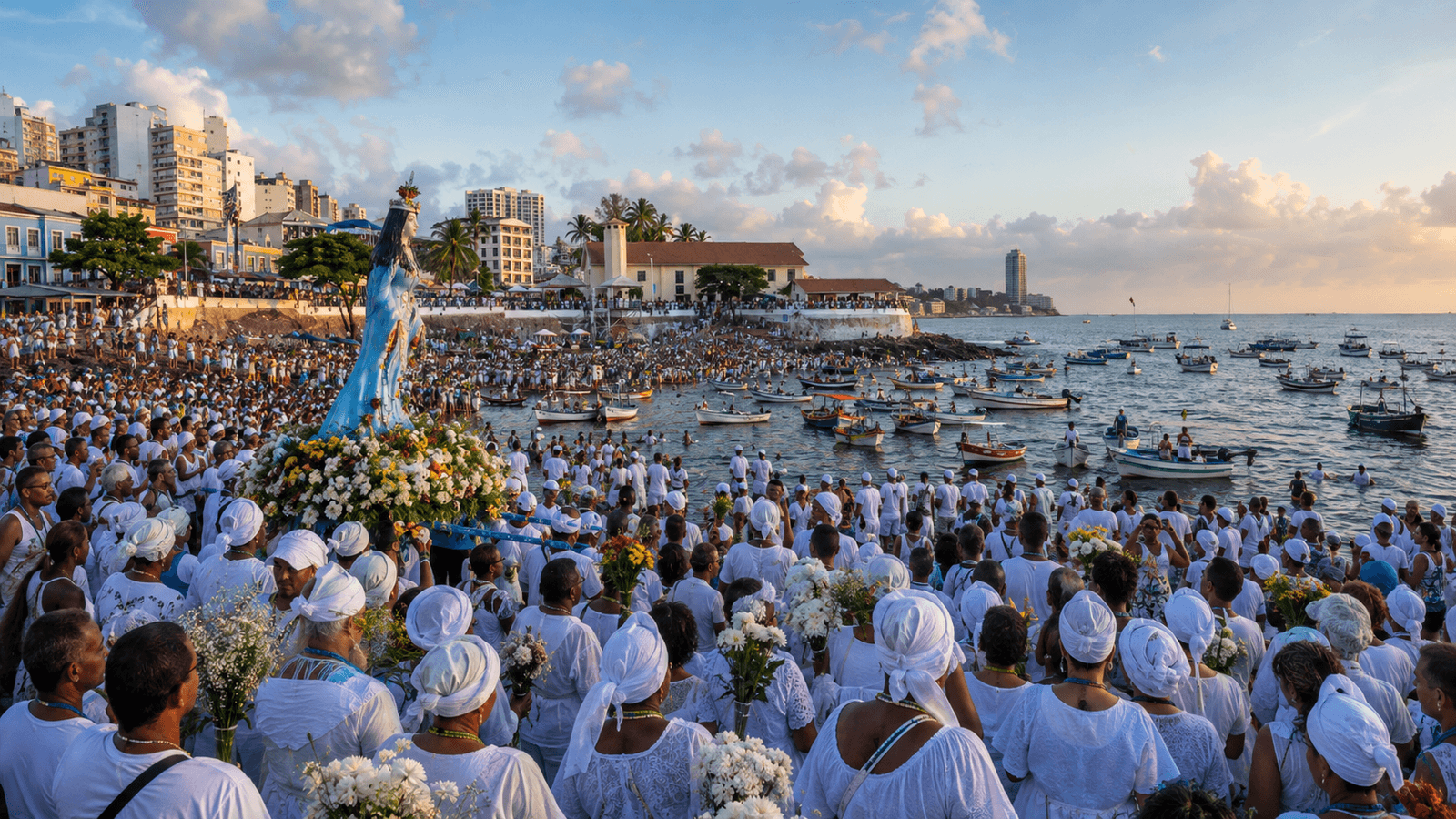
On February 2, Rio Vermelho is not simply hosting another summer event. The neighbourhood becomes the centre of one of Salvador's most important Afro-Brazilian religious celebrations, as devotees, fishermen, residents and visitors gather by the sea to honour Iemanjá. Flowers fill the streets, white and blue dominate the crowd, drums and processions move through the neighbourhood, and the official offerings are eventually taken out to sea by the fishermen.
The essential thing to understand before you go: this is a living religious celebration. The street party, music and private events are part of the atmosphere around it, but they are not the reason the day exists.
Who is Iemanjá?
Iemanjá is an orixá worshipped in Afro-Brazilian religions including Candomblé and Umbanda. In Bahia, she is strongly associated with the sea, motherhood, protection, fertility and the care of those whose lives depend on the water. You will often hear her called Rainha do Mar, the Queen of the Sea, and the name Iemanjá is commonly explained as meaning 'mother whose children are fish'.
That religious context matters. Salvador's February 2 celebration stands out in the city's traditional festival calendar because the homage is directed to an orixá rather than being organised around a Catholic saint's feast. Afro-Brazilian religions in Brazil have a long history of dialogue, coexistence and sometimes forced association with Catholic imagery, but reducing Iemanjá to a Catholic equivalent erases the tradition you have actually come to see.
Why February 2? The Rio Vermelho tradition
The modern Rio Vermelho tradition is generally dated to 1923. According to the historical account preserved by Bahia tourism authorities, local fishermen faced a period of poor catches and offered gifts to Iemanjá asking for abundance and calmer seas. The ritual grew from a fishermen's practice into a citywide celebration, while the Colônia de Pescadores Z1 remained at its centre.
A century later, the celebration is part of Salvador's cultural identity. In 2020 it was formally recognised as Cultural Heritage of Salvador, a status intended to help safeguard the religious and cultural traditions associated with the event.
Where it happens
The heart of the celebration is Rio Vermelho, especially the waterfront around the Colônia de Pescadores Z1 and the Casa de Iemanjá at the Mercado do Peso. The entire surrounding neighbourhood becomes part of the day: streets fill with people carrying flowers, religious groups arrive in procession, musicians and cultural groups circulate, and bars and event spaces run parallel programmes.
Do not plan February 2 in Rio Vermelho as a normal neighbourhood day. Roads close, vehicle access is restricted and walking becomes the default way to move through the festival area.
How the day unfolds
The celebration begins before February 2 feels like morning. Activities at the fishermen's colony and religious events start on the previous day, and by the early hours devotees are already arriving. Around dawn, Rio Vermelho is full of people carrying flowers and offerings, while percussion, prayers and processions announce that the day is underway.
- Before dawn and early morning: devotees, terreiros and cultural groups arrive, and the area around the Casa de Iemanjá becomes increasingly crowded.
- Morning through early afternoon: people leave flowers and other permitted offerings, processions cross the neighbourhood and the waterfront stays continuously busy.
- Afternoon: the official gifts and baskets are prepared for the maritime procession, one of the defining moments of the celebration.
- Later in the day: religious devotion continues while Rio Vermelho also becomes a large popular celebration with music, food, bars and private events.

The maritime procession
The most recognisable moment comes when fishermen take the official offerings out to sea. The main gift is kept at the Casa de Iemanjá together with baskets delivered by devotees and groups, then carried aboard boats that form a procession offshore. From land, thousands of people line the waterfront to watch the boats depart.
Exact departure times and access arrangements are set each year. Treat any hour you see in an older article as historical information, not a promise. If seeing the maritime procession is important to you, check the official programme shortly before your visit and get into Rio Vermelho well before the announced departure.
Flowers, offerings and the sea
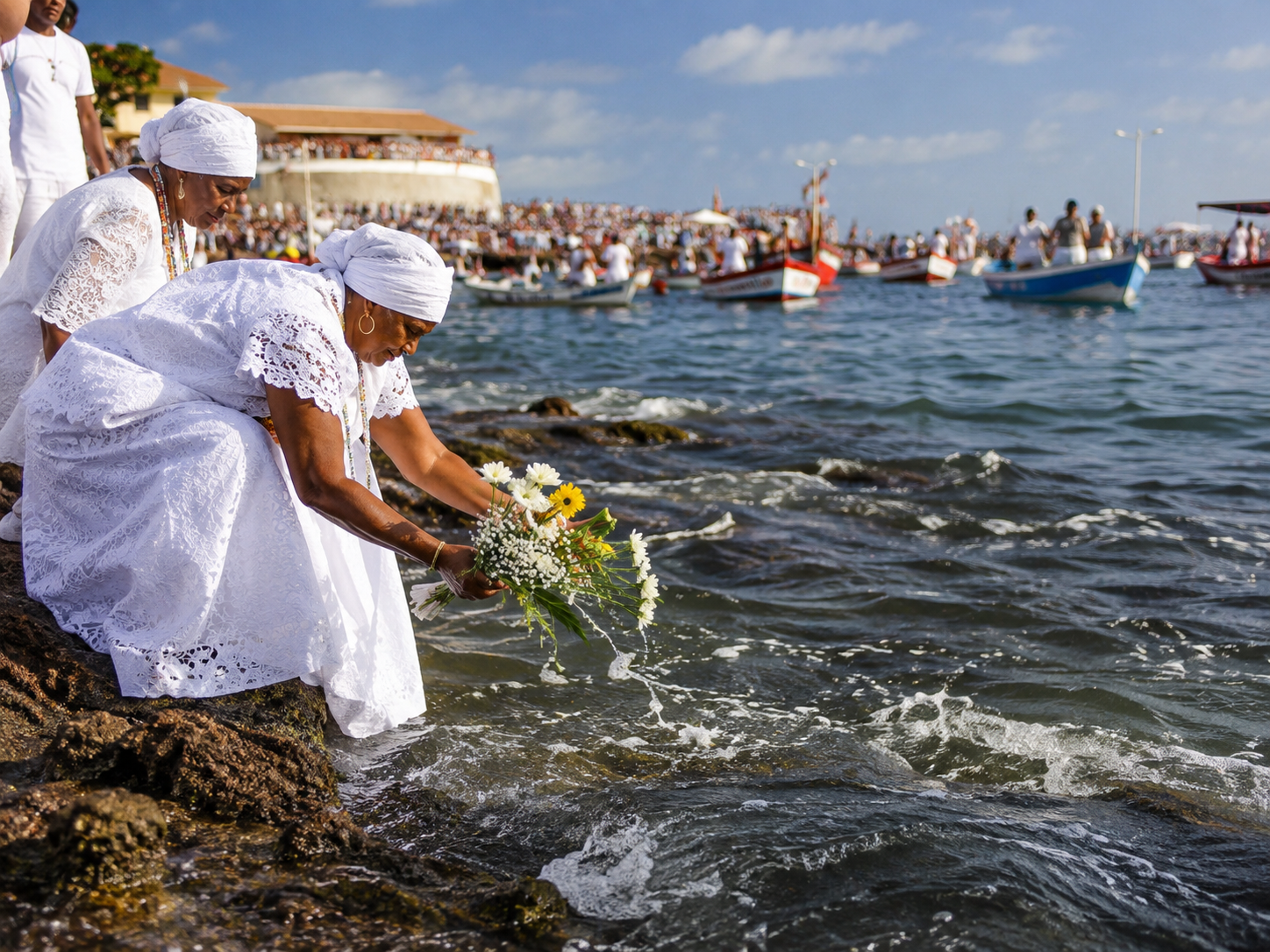
Visitors often want to bring a flower, and that can be done simply. The important shift in recent years is environmental: public authorities, environmental organisations and the fishermen themselves increasingly encourage organic or biodegradable offerings and discourage objects that become marine litter.
- Flowers are the simplest and most appropriate choice for a visitor.
- Avoid plastic wrapping, synthetic ribbons, glass, metal, perfume bottles, mirrors and other objects that can remain in the sea.
- Follow the guidance at the official collection points rather than throwing objects directly into the water.
- An offering is not a tourist prop. If you do not understand the ritual, a flower offered quietly and respectfully is enough.
Respecting Iemanjá also means respecting the sea associated with her. A gift that becomes pollution misses the point rather spectacularly.
How to participate respectfully
You do not need to practise Candomblé or Umbanda to attend. The celebration has long been part of Salvador's public cultural life and welcomes observers, residents and visitors. What matters is understanding when you are watching a public celebration and when you are close to someone's act of faith.
- Ask before taking close-up photographs of individuals performing prayers, blessings or rituals.
- Do not interrupt a procession or step into a religious group simply to get a better photo.
- Treat the Casa de Iemanjá and the official offering area as religious spaces, even when they are surrounded by a huge crowd.
- Listen before explaining. You are visiting a tradition with its own religious authorities, history and vocabulary.
- Street music and private parties can be enjoyed as parties; religious acts should not be treated as performances staged for visitors.
What to wear and bring
White and blue are strongly associated with the day, and many people dress in one or both colours. Visitors are welcome to do the same, but this is not a costume requirement. Dress for a long, hot day in a dense crowd near the sea.
- Light, breathable clothes and comfortable shoes.
- Hat or cap, high-SPF sunscreen and water.
- A small bag that stays close to your body.
- Only the valuables you genuinely need.
- A biodegradable flower if you want to make a simple offering.
Getting there and getting out
Rio Vermelho receives an exceptional concentration of people on February 2 and traffic restrictions affect the surrounding streets. Do not rely on a car reaching your usual drop-off point. Ride-hailing vehicles and taxis may have to stop outside the restricted perimeter, leaving the final stretch to be done on foot.
The return trip deserves as much planning as the arrival. Mobile networks can become congested, meeting points become difficult to describe in a packed neighbourhood, and the obvious pickup streets may be closed. If you are travelling with other people, agree on a fallback meeting place before entering the densest part of the crowd.
Crowds and practical safety
The Festa de Iemanjá attracts a very large crowd. That does not mean approaching the day with fear; it means using the same practical discipline you would use at a major street festival anywhere in the world. Keep your phone out of sight when you are not using it, carry little cash, avoid loose pockets and pay attention when crowd density suddenly increases around a procession or waterfront viewpoint.
If this is your first large street celebration in Salvador, arriving early is usually more valuable than staying late. You see more of the religious dimension, move more easily and experience Rio Vermelho before the afternoon crowd reaches its peak.
Where to stay for Festa de Iemanjá
If February 2 is one of the main reasons for your trip, staying in or close to Rio Vermelho can simplify the day dramatically. You avoid depending on vehicles crossing the restricted area and can return to your accommodation on foot. Ondina is another practical nearby base; Barra is farther away but remains a straightforward area for a first visit to Salvador.
Religion first, street celebration second
As the day advances, the atmosphere changes. Samba, percussion, capoeira and other cultural groups move through the waterfront, while bars, restaurants and event venues promote their own programmes. Some private parties begin on February 1 and continue through the night of February 2. They can be a fun part of the visit, but they should be understood as parallel events around the religious celebration, not as the celebration itself.
A sensible first-time plan
- Check the official programme and traffic plan during the week before February 2.
- Arrive in Rio Vermelho early, preferably in the morning if you want cultural and religious context rather than only the party atmosphere.
- Walk the waterfront slowly and observe before trying to reach the busiest point near the fishermen's colony.
- If you bring an offering, keep it simple and biodegradable.
- Take a break away from the densest crowd during the hottest part of the day.
- Return to the waterfront well before the announced maritime procession if you want to see the boats leave.
- Leave with a transport plan already decided instead of improvising at the moment thousands of other people have the same idea.
Frequently asked questions
- When is Festa de Iemanjá in Salvador?
- The main celebration is every February 2, although activities and religious events begin on February 1 and some parallel cultural programmes extend around the date.
- Where does the celebration happen?
- Its main centre is Rio Vermelho, around the fishermen's colony, Casa de Iemanjá and the waterfront. Other tributes to Iemanjá take place elsewhere in Salvador, but Rio Vermelho is the central February 2 celebration.
- Is Festa de Iemanjá free?
- The public religious celebration and street experience are free. Bars, parties, concerts and private events around Rio Vermelho may charge admission and are separate from the central religious celebration.
- Can tourists attend?
- Yes. The celebration takes place in public space and receives visitors from Brazil and abroad. Attend as a guest: respect religious acts, ask before close-up photography and do not interrupt processions or rituals.
- Do I have to wear white?
- No. White and blue are traditional and widely worn, so choosing those colours can be a respectful gesture, but there is no tourist dress code. Comfort, sun protection and practical footwear matter more.
- What should I offer to Iemanjá?
- For a visitor, flowers are the simplest choice. Avoid plastic, glass, metal and other materials that can pollute the sea, and follow the instructions at the official collection points.
- What time should I arrive?
- There is no single correct hour. Early morning offers more religious context and easier movement; the afternoon is much denser and includes the maritime procession. Confirm that year's official schedule before travelling.
Related reading

Afro-Brazilian Salvador
The museums, institutions and living practices that explain the city better than any postcard.

Where to Stay in Salvador: best areas for first-time visitors
Eight neighbourhoods, compared by beach, nightlife, history, restaurants and first-time suitability.

Salvador for first-time visitors
How the city is laid out, what to prioritise on a short trip, and the mindset that makes Salvador click.