Salvador Carnival
How one of the world's biggest street parties really works. A practical and culturally grounded guide to Salvador Carnival: when it starts, how trio elétricos work, its main circuits, the differences between bloco, pipoca and camarote, where to stay, how to get around, safety and what first-time visitors should know.
Editorial team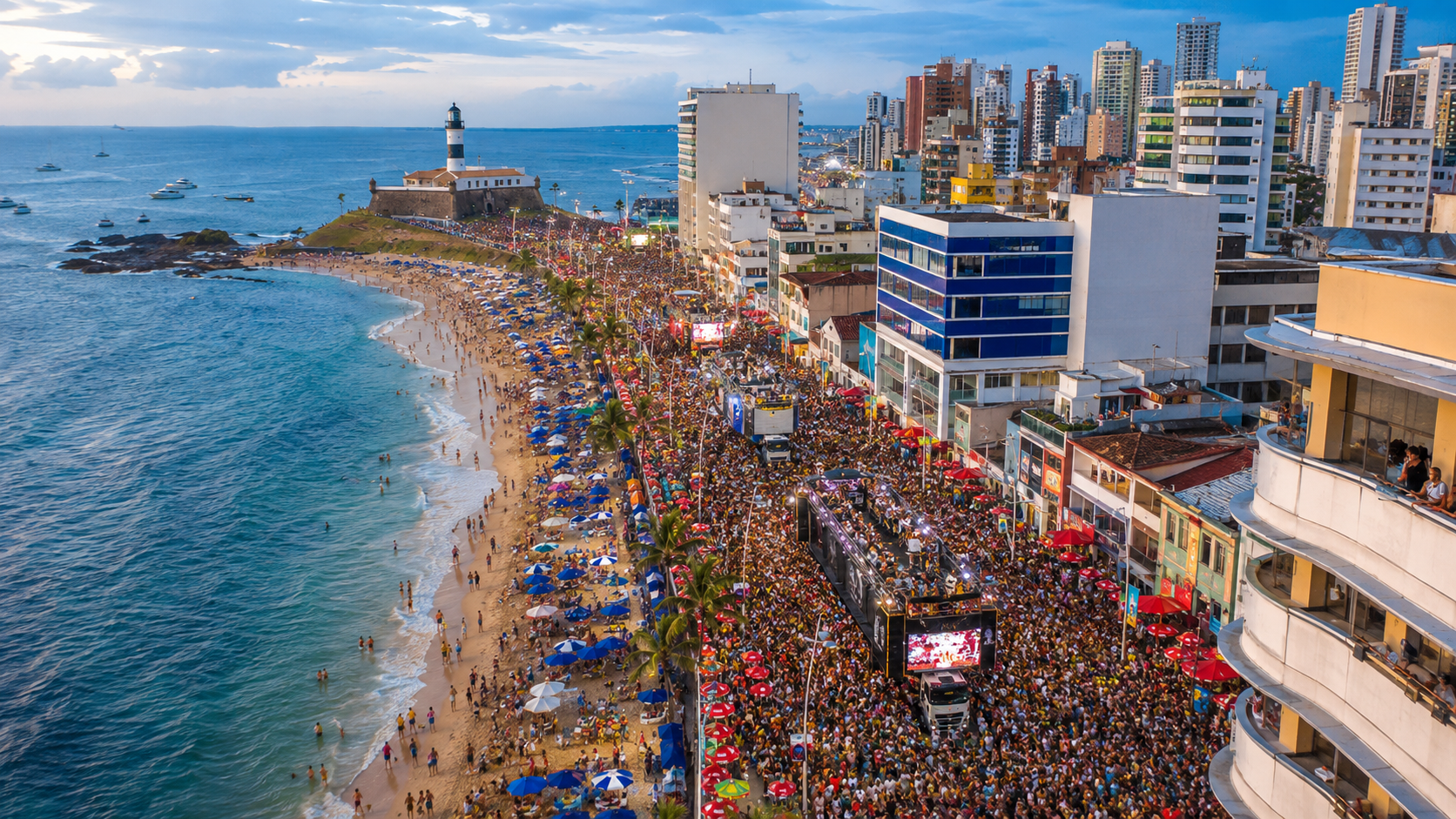
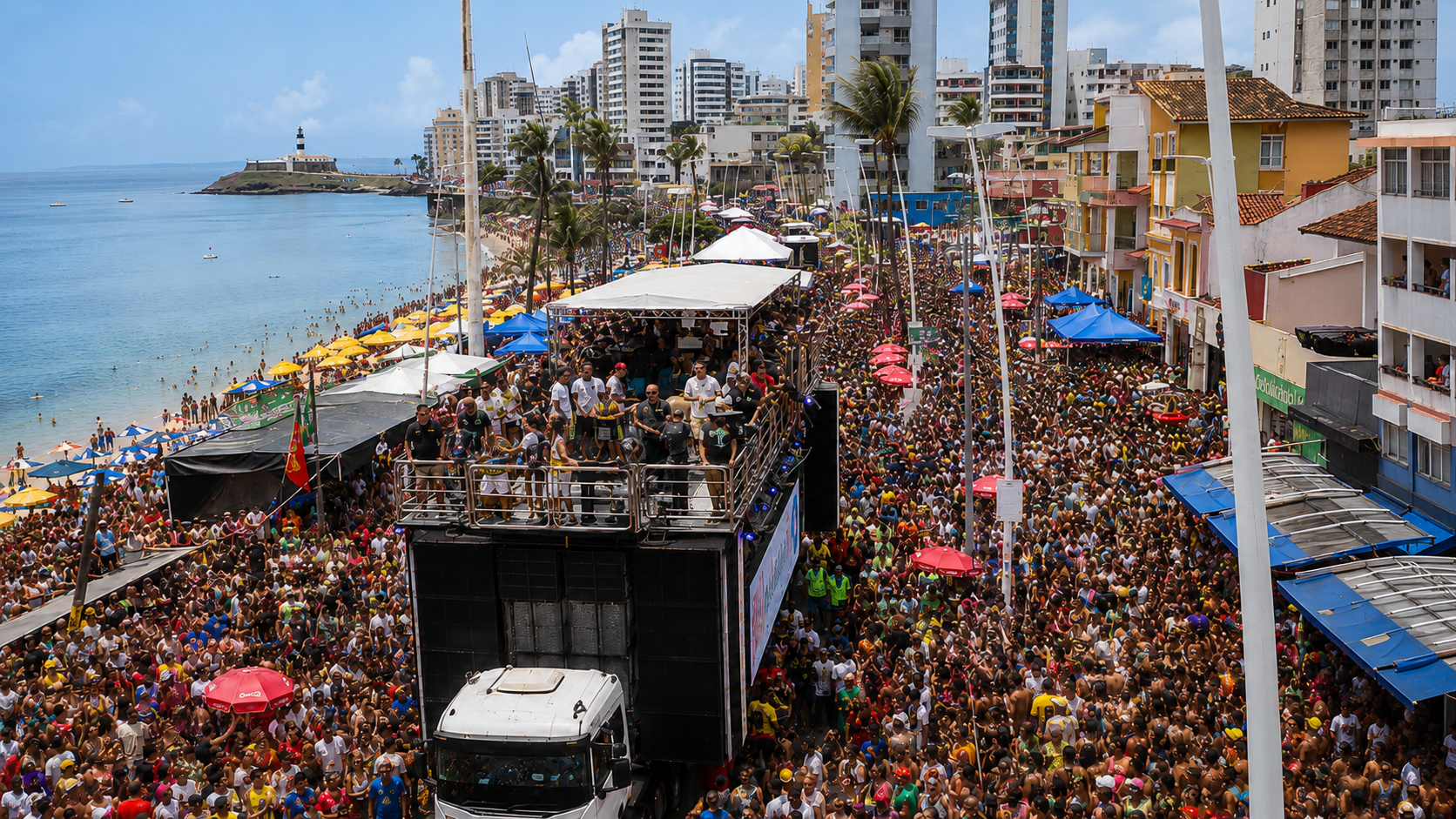
Salvador Carnival is not a parade you sit down to watch. It is a moving city-scale party built around trio elétricos, enormous sound trucks that carry artists through the streets while crowds follow them for kilometres. Some people follow inside a paid bloco, some watch from a fixed camarote and a huge number celebrate freely in the pipoca outside the ropes.
First, understand the Carnival calendar
Carnival Tuesday is the traditional calendar date most closely associated with Carnival, but Salvador does not politely wait until Tuesday to begin. The official street Carnival normally opens on the Thursday before Carnival Tuesday. From that point on, the city celebrates every day and every night through Tuesday and into the morning of Ash Wednesday.
The traditional final act is the Arrastão da Quarta-feira de Cinzas, when the last trio elétricos and artists return to the streets in the morning for one final procession. Only after the Arrastão does Salvador begin to behave as though Carnival might, eventually, be over.
Why Salvador Carnival is different
The key invention is the trio elétrico. In 1950, Dodô and Osmar took amplified music onto a vehicle and played through Salvador's streets. The idea evolved into the giant mobile stages that define the modern Carnival. Instead of the public waiting for the parade to pass, the public moves with the music.
Three ways to experience Salvador Carnival
1. Pipoca
Pipoca is the free street crowd outside the ropes. When an artist performs without a cordoned paid bloco, the public can follow the trio freely; when a paid bloco passes, pipoca occupies the public space outside its ropes. Pipoca is not a separate ticket or a special area. It is Carnival in the open street.
2. Bloco
A bloco is a moving, organised group that follows a specific trio elétrico inside a roped-off area. Access normally requires an abadá, usually a branded shirt or vest that functions as your credential. Security staff carry the ropes as the group advances and a support truck may provide bathrooms, medical support, bars or other services depending on the bloco.
3. Camarote
A camarote is a fixed private structure overlooking part of a circuit. Depending on the product, it may include open bar, food, bathrooms, internal concerts, DJs, beauty services and viewing balconies. Camarotes cost more, but they offer controlled access, private infrastructure and a place to step away from the street crowd.
| Experience | Access | Movement | Best for |
|---|---|---|---|
| Pipoca | Free | You move in the public crowd | Maximum freedom, lowest cost, experienced street-party visitors |
| Bloco | Paid abadá | You follow one trio inside ropes | Following a favourite artist with more structure |
| Camarote | Paid ticket/credential | Fixed venue | Comfort, services, private bathrooms and a controlled base |
The main circuits
Dodô — Barra to Ondina
The Dodô circuit follows the Atlantic waterfront from Barra towards Ondina. It is one of the principal axes of modern Carnival, lined with major camarotes and hotels and used by many of the largest blocos and pipoca attractions. For international first-timers, it is often the easiest circuit to understand geographically because the route simply follows the coast.
Osmar — Campo Grande / Avenida
The Osmar circuit is the traditional Avenida route centred on Campo Grande. It carries enormous historical weight and remains an essential part of the city Carnival. Do not think of it as the lesser alternative to Barra-Ondina: it has its own public, history and atmosphere, and the balance of major attractions between circuits can change from one year to another.
Batatinha — Historic Center / Pelourinho
The Batatinha circuit and the wider Historic Center programme offer a different Carnival: smaller trios, fanfares, costumes, cultural groups, concerts in squares and a more compact heritage setting. It is useful for visitors who want Carnival atmosphere without spending an entire night inside the enormous Barra-Ondina crowd.
The Black Carnival of Salvador
Salvador Carnival cannot be understood through celebrity singers alone. Blocos afro and afoxés transformed the festival into a space of Black identity, aesthetics, music, political affirmation and religious memory. Their influence shaped samba-reggae, the sound of modern Bahian Carnival and the visual language now associated with the city around the world.
- Ilê Aiyê, founded in the 1970s and central to the affirmation of Black identity in Salvador Carnival.
- Olodum, internationally recognised for samba-reggae and community cultural work.
- Muzenza, Malê Debalê, Cortejo Afro and other blocos afro with distinct musical and visual identities.
- Filhos de Gandhy, founded in 1949, one of Salvador's most emblematic afoxés, with strong links to Afro-Brazilian religious tradition.
What is an abadá?
For most blocos and many camarotes, the abadá is your physical credential. It is commonly a branded shirt, vest or customised garment linked to a specific product and day. You may buy online weeks or months in advance and later exchange a voucher or proof of purchase for the physical abadá at an authorised collection point.
- Buy through the organiser, official seller or an established authorised platform.
- Confirm the exact day, bloco or camarote and sector before paying.
- Check when and where the physical credential can be collected.
- Take the identification and proof of purchase required by the seller.
- Be cautious with informal resale and last-minute street offers, especially when the credential cannot be verified.
Choosing a bloco
Choose the artist first, then the day and circuit. A bloco is physically demanding: you may spend several hours walking, dancing and stopping as the trio progresses. Do not buy multiple expensive blocos simply because the names look famous on a schedule. One well-chosen bloco can be a complete Carnival night.
Choosing a camarote
Compare location before comparing the buffet. A beautiful all-inclusive structure is much less useful if it overlooks a stretch where the attractions you care about pass at inconvenient times. Check the viewing position, operating hours, internal line-up, food and drink policy, accessibility, bathrooms and how you will reach and leave the venue under road closures.
Can you enjoy Carnival without buying anything?
Absolutely. A significant part of Salvador Carnival is public and free. Major artists regularly perform as pipoca attractions without ropes, and public stages and Historic Center programmes add more free options. Paying for a bloco or camarote buys a particular structure or experience; it is not a ticket to Carnival itself.
Where to stay during Carnival
During Carnival, neighbourhood choice matters even more than usual because roads close and short-looking journeys can become long walks around security perimeters. If your main interest is the Dodô circuit, Barra and Ondina are the most obvious bases. Vitória and Campo Grande can work well for the Osmar circuit. Rio Vermelho remains attractive for restaurants and nightlife but is not directly on the two main trio routes.
Transport during Carnival
The normal transport map stops being normal during Carnival. Large sections around Barra, Ondina, Campo Grande and other event zones close to private traffic, bus routes are altered, taxi and ride-hailing pickup points move and access control can force you to walk significant final stretches.
Before leaving your accommodation, check the current traffic plan, identify the nearest permitted drop-off point and decide where you will attempt the return journey. Do not assume the car that dropped you at 5 p.m. will be able to reach the same street at 2 a.m.
Taxis: know roughly what the ride should cost
During Carnival you may encounter taxi drivers proposing a fixed negotiated price rather than the fare you would normally expect from the meter or official fare system. Demand, closures and detours genuinely make transport more difficult and expensive, but that does not mean you need to negotiate with no reference at all.
- Before Carnival, learn the normal approximate cost between your accommodation and the circuit areas you expect to use.
- Ask the price before entering if a driver proposes a fixed fare.
- Confirm that the quoted amount is the total price for the journey.
- Use ride-hailing estimates, when available, as a rough comparison rather than an absolute promise.
- Expect a Carnival premium; the useful question is how large that premium is.
Your phone is not part of the costume
Crowd density is one of the defining features of Salvador Carnival. Most people are there to celebrate; a small number are there because enormous crowds create excellent opportunities for theft. The sensible response is not paranoia. It is reducing what you expose to the street.
- Unless you are spending the night inside a camarote, leave expensive watches, jewellery and unnecessary valuables at the hotel.
- Carry only the documents, bank card and cash you genuinely need.
- Keep your phone concealed whenever you are not actively using it.
- Never carry a phone in an exposed back pocket or open handbag.
- Use a small secure pouch or bag worn close to the front of the body.
- Avoid remaining at the edge of a dense crowd with your phone raised for long periods.
This is not an argument for being afraid of Salvador. You are entering a celebration with hundreds of thousands of people, alcohol, movement, noise and anonymity. Those conditions require a different level of care than an ordinary afternoon in Barra.
What to wear and carry
- Comfortable closed shoes. You will walk much more than the map suggests.
- Light clothes that can handle heat, sweat and occasional rain.
- High-SPF sunscreen for daytime events.
- Water whenever practical, and regular hydration breaks.
- A secure small bag or pouch close to the body.
- Ear protection if you are sensitive to very loud amplified music.
LGBTQIA+ visitors during Carnival
LGBTQIA+ people are highly visible throughout Salvador Carnival, in the crowd, on stages and in the city's cultural life. The practical advice is largely the same as for everyone else: choose transport before going out, protect valuables and pay attention to your surroundings in very dense crowds. Our standalone LGBTQIA+ Salvador guide covers neighbourhoods, nightlife and broader social context beyond Carnival week.
Carnival with children
Families do take children to Carnival, but the largest night-time crowds on the main circuits are not the easiest introduction. Historic Center programmes, daytime events and family-oriented attractions are usually more manageable. Exact children's programming changes annually, so plan around the official family schedule rather than improvising with a child inside the densest section of a major trio route.
Accessibility
Accessibility services, reserved viewing areas and assisted transport arrangements may be offered by public authorities and individual camarotes, but the details vary by edition. Visitors with mobility, sensory or other accessibility needs should check the current official accessibility plan and contact any paid venue directly before purchasing.
A sensible first Carnival plan
- Choose your accommodation based on the circuit you expect to use most.
- Before buying a bloco or camarote, understand exactly what the credential includes and where it is located.
- Spend at least one period in pipoca so you understand the public street Carnival rather than experiencing only private infrastructure.
- For your first major circuit night, take fewer valuables than you think you need.
- Check the official traffic and transport plan before leaving your accommodation each day.
- Agree on a fallback meeting point if you are with friends, because mobile networks can become congested.
- Leave enough energy for the final days. Salvador Carnival is not one heroic night; it is a multi-day endurance event disguised as a party.
Frequently asked questions
- When does Salvador Carnival start?
- The official street Carnival normally opens on the Thursday before Carnival Tuesday and continues through Tuesday into the Ash Wednesday morning Arrastão. Pre-Carnival events can begin earlier.
- Is Salvador Carnival free?
- Much of it is. Pipoca attractions, public streets and many public stages are free. Blocos and camarotes are paid optional experiences.
- What is the difference between a bloco and a camarote?
- A bloco moves through the circuit following a trio elétrico inside ropes. A camarote stays in one fixed location overlooking the route and provides private services and infrastructure.
- Do I need an abadá?
- Only for products that require one, such as most blocos and many camarotes. You do not need an abadá to enjoy the public pipoca Carnival.
- Which circuit is best for a first-time visitor?
- There is no universal best circuit. Barra-Ondina is geographically straightforward and concentrates many major products; Campo Grande offers the traditional Avenida experience; the Historic Center is more compact and culturally varied. The current year's line-up should influence the choice.
- Should I take my phone into the street?
- If you need it, take it with a deliberate security plan: keep it concealed, use it briefly and never carry it in an exposed pocket. If you can comfortably leave an expensive primary phone at the hotel and use a cheaper secondary device, Carnival is an excellent occasion to do so.
- How many days should I stay for Carnival?
- If Carnival is the main reason for the trip, arriving by Thursday and leaving after Ash Wednesday lets you experience the official cycle. Arriving earlier adds pre-Carnival events; a shorter stay can work, but you will be choosing only part of the festival.
Related reading

Music in Salvador
From samba-reggae and axé to jazz, MPB and live shows: how to hear and understand Salvador beyond Carnival week.
Read guide
Where to Stay in Salvador: best areas for your trip
Choose the right neighborhood first, then the accommodation: beaches, nightlife, history, quieter residential areas and vacation-rental alternatives.
Read guide
Getting Around
Current fares, two-hour integration, metro maps and the stations visitors are most likely to use.
Read guide