Salvador in 5 days
A five-day Salvador itinerary for a first trip: Historic Center, Ribeira and Bonfim, Rio Vermelho, Salvador Zoo, Vitória and Barra, with food, culture and sunset stops built into the route.
Editorial team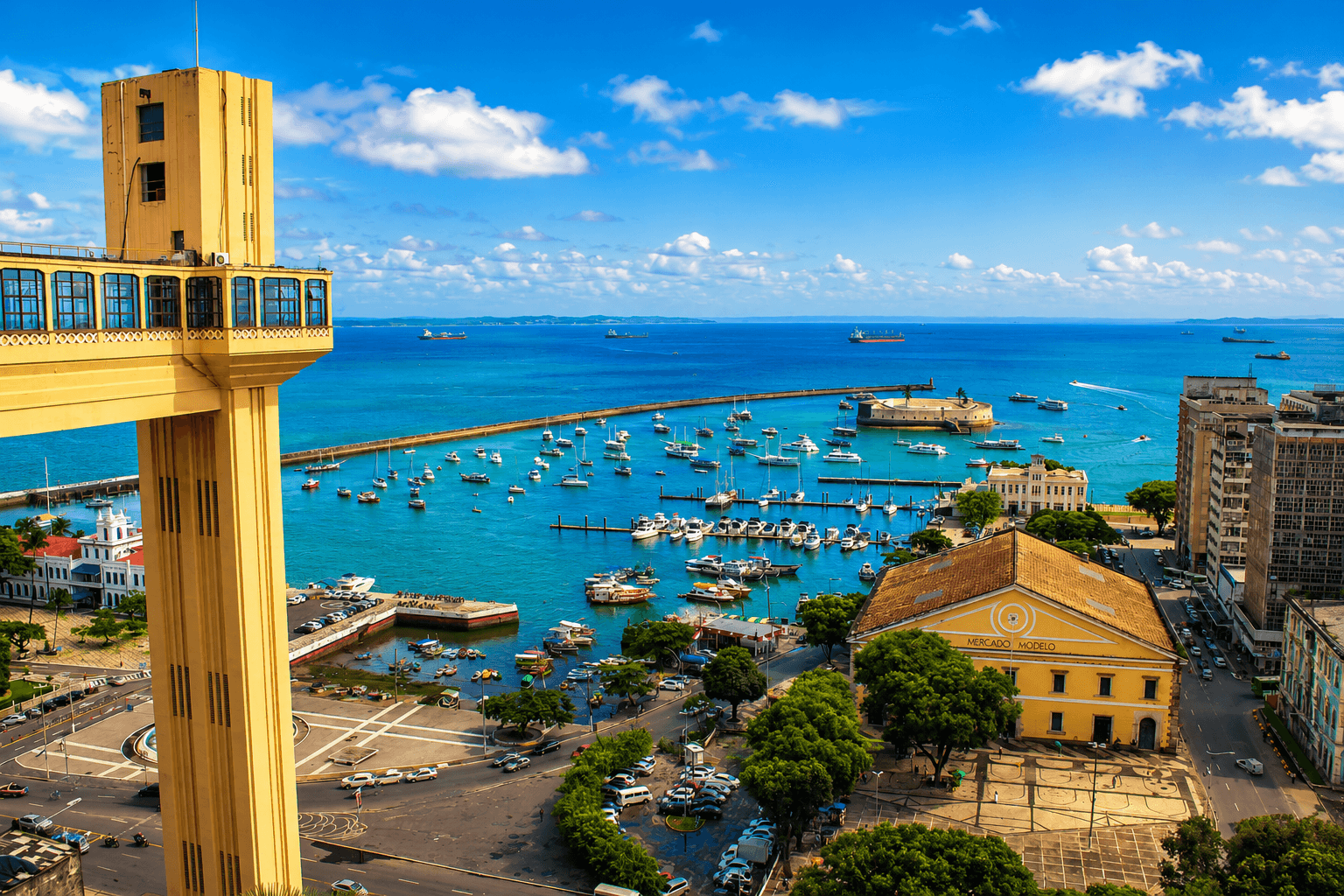
This is the itinerary we would give a friend arriving for the first time with five full days. Each day stays inside one area, so you spend your energy on places rather than on traffic.
Day 1
Historic Center and Pelourinho
This first day introduces the historical layers that shaped Salvador, moving from one of its oldest religious institutions toward the colonial, African-Brazilian, political and commercial heart of the city.
One of Salvador’s oldest religious institutions, founded in the 16th century. The Benedictine tradition is still active here, and Gregorian chant remains part of monastic religious life, so this is more than a historic façade.
Praça da Sé + Terreiro de Jesus
These neighboring squares concentrate churches, civic space and several layers of Salvador’s colonial center. Do not try to enter every church: choose the ones that interest you and use the walk to understand how religion helped organize the old city.
Igreja e Convento de São Francisco
Go inside to understand why this complex is one of the great visual statements of colonial Salvador. Its baroque decoration, woodcarving and gilded interiors reveal both the wealth and the contradictions of the society that produced them.
Lunch is part of the itinerary here, not merely a pause. SENAC offers a practical first introduction to Bahian cuisine because you can encounter several traditional preparations in the same meal and start recognizing flavors that will appear again during the trip.
This is one of the most important context stops of the day. It places African and Afro-Brazilian cultures at the center of Salvador’s formation rather than treating them as a footnote to the colonial architecture outside.
The historic complex is linked to the Santa Casa da Bahia, whose history begins in the first years of Salvador. Sacred art, furniture, an old pharmacy and records of social and medical activity offer another way to read the city across almost five centuries.
Praça Municipal has been associated with political power since Salvador was founded in 1549. The palace has been rebuilt and transformed several times, including after the 1912 bombing, making this stop a useful way to understand why this hilltop was the administrative heart of the city.
The elevator is not only a viewpoint or a famous photograph. It makes Salvador’s geography tangible by linking Cidade Alta and Cidade Baixa, two levels that shaped how the city developed and still influence how you move through it today.
Finish the lower-city part of the route here, between the market, Comércio and the bay. You do not need to turn the visit into a shopping mission: the point is also to see how tourism, crafts, commerce and the waterfront meet in the Cidade Baixa.
Optional: return at dusk
If you still have energy, return to the Historic Center in the late afternoon. The streets change with the light and the atmosphere becomes less about visiting monuments and more about simply being in the neighborhood; stay for dinner if it feels right.
Day 2
Ribeira, Bonfim and the Lower City
Today reveals a more everyday Salvador, shaped by traditional neighborhoods, popular religion and a close relationship with Baía de Todos-os-Santos. The route follows the Itapagipe Peninsula toward Humaitá, combining local life, food, faith and bay views.
Ribeira
Begin in one of the traditional neighborhoods of the Itapagipe Peninsula, where life still faces the bay rather than the Atlantic. Starting here gives the day a local rhythm and lets the route move forward naturally toward Bonfim and Humaitá without backtracking.
This restored 1904 mansion gives Ribeira an unexpected cultural stop. Its historic interiors now share space with the Museu do Sorvete, bringing together architecture, memory and the history of ice cream in a building that once belonged to another Salvador.
A neighborhood institution since 1931 and an excellent excuse to try tropical fruit flavors that may be unfamiliar. Ask to taste a flavor before choosing: cajá, mangaba, graviola or umbu are considerably more interesting when you know what you are ordering.
Bonfim is much more than a church with colorful ribbons on its railings. It is one of Salvador’s great symbols of popular devotion, where Catholic practice and Afro-Brazilian cultural traditions have long intersected in the life of the city. Notice the fitinhas, but pay attention to the people and rituals around them too.
Boa Viagem
From Bonfim, the route returns toward the water. Boa Viagem works as a transition between religious Salvador and the defensive landscape of the bay, with the coastline gradually opening toward Monte Serrat and Humaitá.
The fort makes the strategic geography of the bay easier to understand. Its position above the water explains why this point mattered for the defense of Salvador, while the view introduces the final landscape of the day.
End the route where the peninsula projects into Baía de Todos-os-Santos. The appeal is simple: open water, the city in the distance and a sunset that feels connected to everything you have seen along Itapagipe rather than added as a separate attraction.
After sunset
Return to your hotel and have dinner near where you are staying. There is no reason to add another long journey just because a travel itinerary feels guilty when it leaves an hour unoccupied.
Day 3
Rio Vermelho
Rio Vermelho changes completely with the time of day. During daylight, choose one beach and slow down; at night, the neighborhood becomes a compact center for food, bars, music and social life.
Daytime: choose one beach
Do not treat Paciência and Buracão as two tasks to complete. Pick one, stay for a while and let the first half of the day be deliberately slow.
Small and more sheltered, Paciência has an intimate neighborhood feel. At low tide, rocks can form calmer pools, making it a good choice if you want a quieter beach break. Sea conditions still matter, so observe the water before swimming.
Buracão feels more hidden and distinctly local, with a small strip of sand below the neighborhood. The sea is often rougher here than at Paciência, so come for the atmosphere and scenery but be conservative about swimming when conditions are not inviting.
At night: choose your kind of evening
Rio Vermelho works because very different evenings coexist within a compact area. Choose the profile that suits you instead of trying to visit every address below.
Bars and casual food
Choose this if you want a loose evening built around drinks, street food, boteco culture and moving between places without committing to a formal dinner. One or two stops are enough.
Restaurants
Choose this profile when dinner itself is the main event. La Taperia offers a different, small-plate style of evening, while Casa de Tereza is a stronger choice when you want Bahian cuisine in a more composed restaurant setting.
Bars and music
Use these options when music matters as much as the drink in your hand. Programming changes, sometimes quickly, so check what is actually happening that night before choosing the venue.
LGBTQIA+
Amsterdam is the explicitly LGBTQIA+ option in this shortlist. Treat it like any nightlife recommendation: confirm the current program before going, because a venue is only useful if something you actually want to attend is happening that night.
Day 4
Zoo, free afternoon and Northeastern flavors
After three busy days, this day deliberately slows down: one planned morning visit, an intentionally free afternoon, and dinner focused on another side of Northeastern Brazilian cuisine.
The zoo occupies a green area within Atlantic Forest vegetation, which makes the visit feel surprisingly removed from the surrounding city. Admission is free. The route can also be hot and humid, so bring water instead of discovering halfway through the walk that optimism is not hydration.
The free afternoon is intentional
After three full days, the itinerary deliberately leaves space to rest, go to the beach, shop, return somewhere you liked or simply do nothing. Free time is part of the plan here, not evidence that Salvador ran out of things to do.
Dinner widens the culinary map beyond the easy equation Salvador = Bahia = dendê. Salvador is also part of Brazil’s Northeast, a region with many distinct food traditions. Picuí brings some of that wider picture to the table through dishes and ingredients such as carne de sol, feijão-de-corda, cassava and other Northeastern specialties.
Day 5
Campo Grande, Vitória and Barra
Starting in the upper city in the early afternoon, this final route descends through gardens, museums and Corredor da Vitória toward the Atlantic coast, ending at Barra for sunset.
Start in the upper city, in a broad garden and civic space that feels very different from Pelourinho. It introduces the more institutional, residential and landscaped Salvador that will define the first half of this final route.
Corredor da Vitória
Walking into Vitória reveals another layer of Salvador: a traditional residential avenue lined with cultural institutions, old houses and modern buildings overlooking the bay. The contrast with the colonial center is precisely why it belongs in the final day.
Choose this museum if geology, minerals, fossils and the natural history behind Bahia’s landscapes interest you. It changes the subject of the trip completely for an hour, which is precisely its charm.
Choose this one if you prefer art, furniture and decorative objects that help tell the cultural history of Bahia. You do not need to visit both museums; the point is to choose the collection that genuinely interests you.
Pause here because the bay finally opens beneath the route. After spending part of the afternoon among buildings and museums, the view reconnects the walk with Baía de Todos-os-Santos and prepares the descent toward the sea.
This is an optional cultural extension, not another box to tick. The historic mansion is now devoted mainly to visual arts and temporary exhibitions, while its garden includes bronze works by Auguste Rodin. Go in if the current exhibition interests you; otherwise keep walking.
Ladeira da Barra
From here the route stops being a museum walk and becomes a descent toward the coast. Follow the slope instead of fighting Salvador’s topography: the city gradually opens from the upper neighborhoods to the sea.
Arrive with enough time to slow down again. The small bay faces Baía de Todos-os-Santos rather than the open Atlantic, so this is a good place to sit, walk or spend a little time by the water before the final stretch.
Finish where the bay meets the Atlantic. After five days moving through history, neighborhoods, religion, food and different waterfronts, the lighthouse gives the itinerary a natural final image: stay for sunset instead of adding one more attraction.
Related reading

Salvador in 3 days
The sweet spot for a first trip: history, coast and bay.
Read guide
Afro-Brazilian Salvador itinerary
Three days that treat Afro-Brazilian Bahia as the main subject, not a side trip.
Read guide
All Saints Bay & Islands
The bay is part of Salvador's geography, history and everyday life. Start with the context, then choose the island that fits your day.
Read guide